Wednesday, February 9, 2011

A Whale of a Time in Maritime Adventures

By Sabin Mustafa

There’s something special about being told a story without being read to from a book. Maybe it’s the accompanying actions and expressions. Perhaps it just takes us back to a time, when there weren’t books and pictures to nudge us on, but just our imagination to take us for an incredible journey. The Maritime Museum in Karachi was a marvellous setting for the story of Hazrat Younus (AS). The Quran also refers to him as Zunnoon, and his plight has been narrated in Allah’s (swt) words. Our families all excitedly gathered at the venue, full of anticipation in this variation of our weekly session of Bookworm’s book club. Though the club meetings are usually held at Laila Khala’s cosy and welcoming home, we occasionally allow her a break, take our little troupe to other locations, and carry on the entertainment.

As she told the thrilling story of Hazrat Younus (AS), Atefa Khala’s billowing Abaya was ideal in enhancing the demonstration of thunderstorm, strong gales, and darkness. Many kids knew the story and were quick to chip in with their contributions. Atefa Khala explained how Hazrat Younus (AS) had run from his Master, the terrors he went through, and what the experience inside the whale’s stomach might have been like. She went on with how prophet Younus (AS) prayed to Allah (swt), how Allah helped him out of his predicament and bestowed His favours upon him, when he reached the shores.

Our mental image of the whale’s dimensions, the fascinating creature that played an important role in the story, was elucidated when the group marched to the indoors section of the museum. We saw the real skeleton of a baby whale, which had been beached on the shores of Karachi many years ago. The suspended skeleton was huge! It was fascinating to inspect the bones and compare them with dinosaurs’ skeletons, which appear similar in size.

After story time, we spread out all the scrumptious snacks we had for our picnic: biscuits, pasta, noodles, sandwiches, Samosas, salad, and drinks. We enjoyed the feast on three mats: one for girls, one for boys and one for ladies. We chattered and babbled, and gobbled the food in the shade of a large tree. The moist grass didn’t dampen our spirits, and the kids thoroughly enjoyed running around in the vast lawn, with the elder ones fetching the little ones back every now and then! The kids messed their clothes climbing on the small freshly painted vessel. We observed squirrels scurrying about and a beehive, which was built on a small tree about six feet high, was very close and extremely tempting to poke and prod, though, Alhamdulillah, none of the children did!

The Maritime museum is spread over 28 acres comprising picturesque landscape and a magnificent building with a grand flight of steps. Spring flowers welcomed us everywhere. The museum building consists of six galleries: Maritime History Gallery, Pakistan Navy Gallery, Ports and Harbours Gallery, Marine Life Gallery, Photographic Gallery, and the Chief’s Gallery.
Various naval artefacts have been preserved or replicas recreated. The displays include an enlightening map showing the history of the conquest of the subcontinent by the Muslim teenage leader Muhammad bin Qasim. The children were given a synopsis of his great character and feats. There are depictions of different battles, and the defence and warfare schemes employed. Equipment used is displayed and technological development through the years is explained. Children loved the large marine gallery, where they saw, how life exists underwater: different types of corals, sea creatures, such as starfish, barnacles, crabs, shells, sharks and other fish swimming in the sea (well more like hovering in the air...) are inside the ocean minus the water! In another section, there are large aquariums full of large and small fish, real fish, which are always so relaxing to watch. There are paintings of many of the masters, but a large painting illustrating the transformation of the Pakistan coastline over the years was a homeschooling mother’s favourite.

Outdoors, the prominent landmarks include a lighthouse (close to which we had our picnic), a minesweeper, a submarine, a naval ship and a marine fighter plane. Our naval heritage has been beautifully preserved and our families split up to view and enjoy the museum. There is a vast artificial lake with goldfish and carp, ducks and geese. Some of us took a guided tour of the submarine anchored in the lake, where we could look through the periscope, examine living quarters, the radio and sonar equipment, and also watch a video about the Daphne submarine and how it was used to destroy an Indian ship during war. It was a captivating narrative, made more interesting, as we tried to decipher the intermingling naval jargon and that too in Urdu!

Some of us visited the naval plane, where a guide presented another video, let the children inspect the cockpit, and pointed out interesting items like the rigid little seat in the nose of the plane, which was used for a 360 degree view during flight, and levers used to fire missiles! The kind gentleman showed us how the original entrance was really at the back where the equipment and naval soldiers climbed aboard. The door we used had been cut out for the museum visitors. We also viewed other weaponry, vessels, monuments and equipment on display scattered all over the grounds.

The spring cheeriness was manifest in the wonderful blossoms and plants flourishing throughout the gardens - quite a flower show! The families examined them, took pictures and discussed their common names and genus. Alhamdulillah, we didn’t pick the flowers or spoil the foliage in any way. The wonderful manners, sharing, caring, kindness and cooperation that blossoms in our group made the field trip even more enjoyable. May Allah (swt) strengthen our bonds and put Barakah in our group, our Jama’ah.

Perhaps only in homeschooling can we have a book club session without a book in sight! It is the essence of knowledge imparted beautifully in a variety of approaches that makes each step in our learning adventure so memorable. The Maritime Museum is a wonderful place to visit; even better, when you are there with fantastic friends on an exploring expedition!

Wednesday, February 2, 2011

Book club at the Piranis' home

By Atefa Jamal

This week the Bookworm Club gathered at the Piranis’ home, Alhumudlillah. The club members all sat in a circle in the balcony so they could enjoy the wind and sunlight outdoors. Isa read the book “Pizza In His Pocket" to his friends, which was a story about a little boy who loved to eat food from different places around the world, but never thanked Allah (SWT) for the food. Then, one day he met a girl, who hadn’t eaten anything in a long time and was holding her tummy in pain. The boy felt ashamed about his own greediness and bought some food for the girl and her family and they all thanked Allah (SWT) for it. The book advises us to eat all the food our parents give us, including vegetables, without a fuss and share our food too and reminds us that “being thankful is what’s really great, eat the veggies on your plate and don’t be like the boy, who ate and ate and ATE!”

After the story, the club members had a short discussion on eating etiquettes in Islam: to start with Bismillah, use your right hand when eating and which Dua to say once done.

Then we moved on to the activity. The members divided themselves into three groups, each group was given an Atlas and a mother sat with them to help them use it. A large Globe Trotter Twister mat was laid out. Ummibaps called out the name of the countries and cities the boy in the book visited, and the groups raced each other to locate it in their atlas. The group who found the country/city would then send one of their members to stick the place’s name card in the correct place on the Globe Trotters mat.

Once all the places were located, the second part of the activity began. The Ummibaps and Qasim then called out the names of the different dishes the boy in the book had enjoyed. The members had to remember which country/city the boy had received the meal from and then take turns to stick the picture of the meal onto the correct place’s namecard.

Alhumdulillah, it was fun, and we discovered places we had never heard of on the map and we also realized that not all atlas have the same cities marked on their “political world map” pages Subhan’Allah!


Wednesday, November 3, 2010

27th meeting

Our Today's Story: "How Many Jawbreakers?" from "Kids-Life Devotions"

After a week off due to the spell of sickness that Umm Uzair's family went through, we were happy to come together for another book club meeting.

As we were waiting for all the kids to arrive, Umm Uzair decided to switch around the usual order of our book club. This time, we started with the crafts activity. As Umm Uzair handed out to each of us a square piece of paper, she told us about the ancient Chinese art of origami - folding of paper into different shapes. She told us that already in one of the earlier book club meetings, kids had dome some origami. This time, she had in mind for us a project of origami steamer-ship. Folding was simple but not easy, as we always had to match the corners and edges of paper folds most carefully and make sure that all the folding lines were tightly pressed. Here below you can see the pictures of the ships we made.

After we finished the ships, Umm Uzair handed to us a long piece of paper, which was left over from the A4 size pages after cutting out squares. In order not to waste the paper, we cut out from these edges lovely strings of little men and women, who could sail our ships!

Then we sat down for the story. Umm Uzair asked us, if we liked to win in competitions and how we felt, when we were the winners. All of us agreed that it felt very good to win and to receive certificates or gifts for our achievements. The story that we read this time was about a boy, who also really liked winning and wanted to win in a competition arrange by his class teacher. It was called "How Many Jawbrakers?" and the main character of the story was Andy Jackson.

One day, Andy's class teacher had on her table a big jar full of jawbreakers. (Umm Uzair explained to us that jawbrakers were very large balls of chewing-gum, which, when eaten, filled the entire mouth and thus were difficult to chew. Since chewing them took a lot of effort, they were called 'the jawbrakers'.) The teacher announced a competition - she asked children to guess, just how many jawbrakers were in the jar. The one with the closest estimate (that's a fancy word for 'guess' that we learned) would get the whole jar. Andy really wanted the jar.

When the break came, all the kids run outside. Teacher sent Andy back to class to bring a whistle she had forgotten on her table. As Andy was taking the whistle, he noticed a note on the table saying "732 jawbreakers". He couldn't believe his luck - he saw the answer!

Later, when teacher asked the kids to write down their guesses, Andy was puzzled what to do. He prayed to Allah to help him to make the right choice. Finally, he decided not to cheat and instead of 732, he wrote down as his guess 237 - just the opposite number of what he had seen. He was said he wouldn't win, but he felt good because he had done the right thing.

When the teacher announced the results, it turned out that Andy had the closest guess and won the whole jar of jawbreakers!!! How so? The note he had seen on the teachers table was not the answer - it was a guess made by a girl, who had to leave early! Thus, by being honest and doing the right thing, Andy won.

Umm Uzair encouraged also us to pray to Allah, whenever we faced any difficult situation and didn't know what to do. Allah can always help us to make the right choice!

Wednesday, October 20, 2010

26th meeting

Our Today's Story: "Dick Whittington and His Cat" from "Folk Tales from Around the World"

We started out today our book club by trying to define, what a folk tale was. Umm Uzair tried to ask us prompting questions till we one by one pieced together a quite good definition. We decided that folk tales have to do with certain peoples, and that these are the tales that they tell to each other. From here on, Umm Uzair explained to us that people all over the world have some special tales that are being narrated down from generation to generation. For example, your mom's mother might have told her a tale, which was told to her by her mother, and then your mother told that the same tale to you - that's how folk tales are being passed down and preserved in memories of different nations. Usually, nobody knows, who is the author of the tale.
We also learned that different nations of the world have very different folk tales, which are specific to the regions they live in. The book, which Umm Uzair had, contained folk tales from West Africa, Germany, the USA, Britan and Japan. We listened to the tale from Britain about a poor boy called Dick and about his cat Tom, who made him rich by serving on a ship and catching the mice.

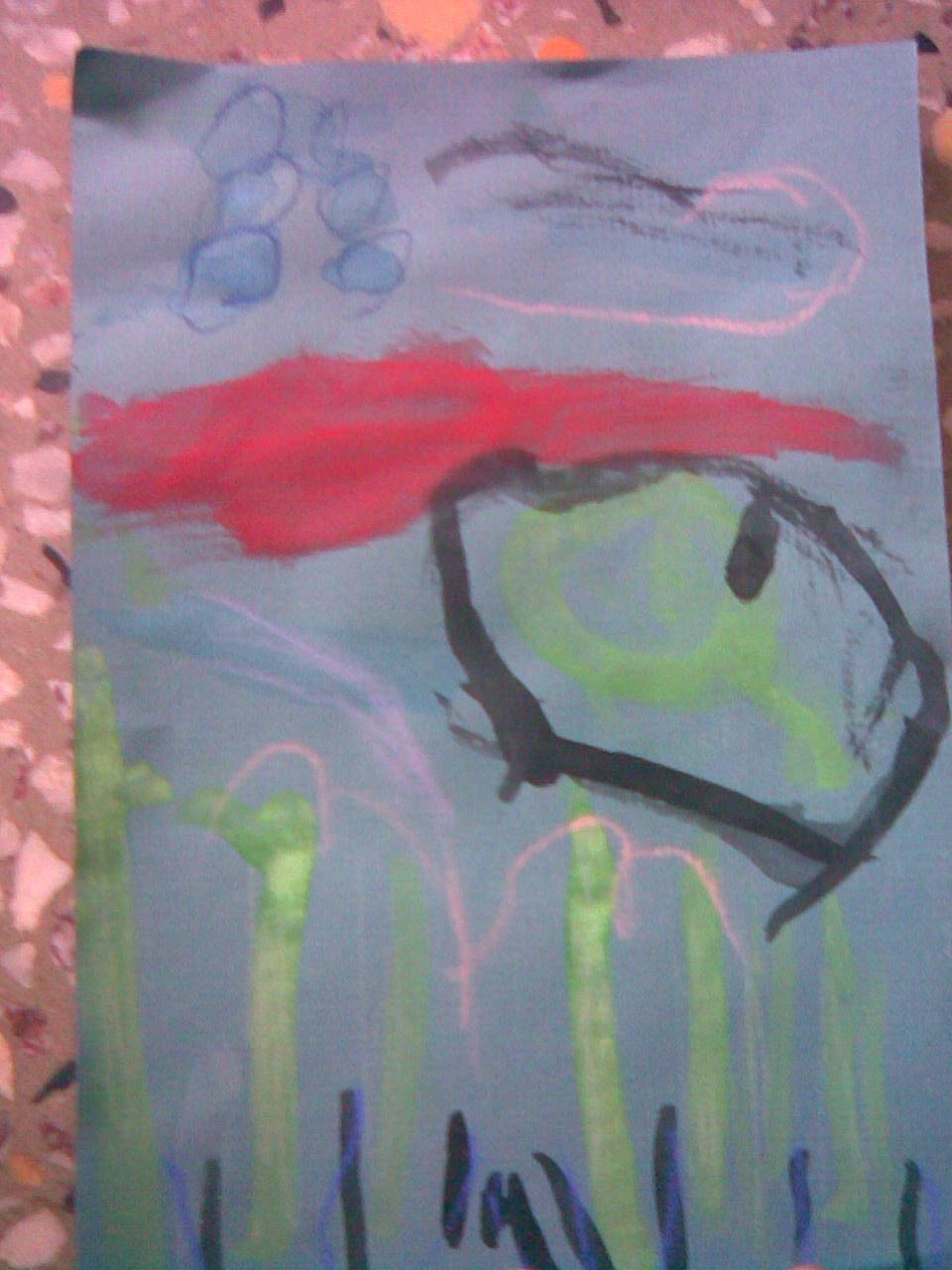
After the story, Umm Uzair had prepared for us a painting activity! All of us together made beautiful pictues of the under-water world. Umm Uzair was making her picture and we followed her step-by-step in making our own. First, we put all the colours and then, when the paint had dried, made the outlines with bright pastels. See below the pictures we made!


Wednesday, October 6, 2010

25th meeting

Today's Story: "The Gingerbread Man"

This week, the location of our book club meeting was moved to the home of Atefa aunty, who kindly invited all the kids and their moms over.

Inspired by the previous week's book club, in which Imaan was sharing with kids a story, this time, Uzair decided to read for children one of his favourite stories - "The Gingerbread Man". Now, nearly all of us were familiar with this story already, but it didn't stop us from enjoying listening to it again. We liked how Uzair tried to read the parts of different characters in different voices. Plus, this book had more in it than just the story of the Gingerbread Man. At the story of Gingerbread Man, we had the chance to see a comic story of what the same moning (that he book talks about) would have looked like for the fox - what the fox did in the morning, before he saw the gingerbread man at the river. Moreover, there was also a diary entry of the two children, who were also chasing the gingerbread man - they were also telling their own version of the story up to the point, when the gingerbread man escaped with the fox. By reading these additional stories, we realized that we could do the same with nearly every story we read - we could imagine, what the story would be like for the other characters involved in it! :)

Before we sat down for the story, we had the chance to cut out our very own shapes of gingerbread cookies! Umm Uzair had prepared the dough for us, and the gingerbread cookies were cooking in Atefa auntie's oven, as we listened to the story, spreading a mouth-watering smell all over the house! What a delight it was to eat the warm cookies later on!

After the story, Umm Uzair gave to each of us a paper gingerbread man, which we could decorate with pencils and crayon whichever way we wished. When we finished the work, she attached our gingerbread men to sheets of paper with recipe of gingerbread cookies, so that our moms could make some for us at home as well. :) See below our work!


Wednesday, September 29, 2010

24th meeting

Our today's story: "Stellaluna" by by Janell Cannon

Today was a special day for our Bookworks Book Club because for the first time one of the book club members had taken the responsibility of sharing a book with us! Imaan had brought along one of her favourite books "Stellaluna", which she read to the rest of us.

The story was about a little baby bat by name of Stellaluna, who got lost and ended up being raised by a bird in her nest along with her other little birdies. Stellaluna had to do all things the way birds do - eat insects, which she didn't like at all, and instead of sleeping by hanging upside down, as bats do, sleep like birds do in their nest.

Later, Stellaluna met some other bats, who said to her that it was OK to sleep by hanging upside down, because she was a bat. Stellaluna also discovered that she was a fruit-bat, which explained why she hadn't liked the insects the birds were eating. She learned that she could see very well at night and that her hearing was extremely sensitive - she could move aroun with the help of echolocation (bats make sounds and listen to them coming back in echo for judgeing the distance to objects around them). At the end of the story, Stellaluna was lucky enough to find her mother again!

After the story, Imaan's mother helped us to discover some more interesting facts about bats. We got to know, for example, that bats are mammals (their babies are born alive and drink milk) and that fruit-bats find their food by following the smell of it. What was even more fun, we ourselves could try becoming bats by using our senses of smell and hearing! We did two interesting activities. First, Imaan's mother divided us into pairs. One of us had to close our eyes, while the other gave to the first one some fruit to smell. We had to guess blindfolded, what kind of fruit it was - just like bats recognize and find fruits with the sense of their smell! The second activity was for our ears. With the help of a wall, a big lound-ticking clock and some empty kitchen towel rolls, Imaan's mother set up a small experiment, in which we could hear the echo of the clock's ticking, as it bounced off from the wall!

The pictures below show some of the facts we learned about bats: 1) bats are active during the dark hours (at night); 2) bats have good eyesight at night; 3) bats sleep by hanging upside down and wrapping their wings around them; 4) bats have sensitive sense of hearing and use echolocation.

Wednesday, September 22, 2010

23rd meeeting

Our today's story: "Wake Up, Scooterville" by Judith Bauer Stamper

All of us were happy to see each other again, after the longer break Bookworms Book Club took for the Ramadan and the Eid. As we sat down on the carpet for the story time, we agreed that all us had had really great Eid this year and all of us wished that the holidays would have beeen loger - not just four days but a week, a month, or, as somebody suggested, even thousand years! ;) Now from this you can easily guess that all of us really like to have long holidays.

Today's story was about a family living in a town called Scooterville. The characters in the book were: Mrs. Johnson (the mother), Ky and Alice (her kids). Every morning as they were having their breakfast, the Johnson family liked to listen to a radio show hosted by Howie Brown.

So it happened that one day Howie Brown decided to hold on his radio show a mystery contest that would last for three days. Each day, he was giving a clue to this mystery. The whole Scooterville was excited about this contest and everybody wanted to win. However, it was Alice, who was the lucky one to guess the right answer for the mystery contest. It turned out that Howie Brown had been giving clues about the Scooter Creek that was flowing through the town. He wanted the people of the town to 'wake up' and pay attention to the sad situation the creek was in - it was very polluted and dirty. Once the contest was over and Alice had won, the whole village went out to the Scooter Creek and cleaned it up from all the garbage.

After the story, Umm Uzair handed to us small pieces of paper with some mysterious letters on them, which we were supposed to colour. We coloured them, wrote our names on them and handed them back to Umm Uzair. As we were having our snack later on, Umm Uzair showed us the solution to our mystery - each of us had been colouring a part of a big poster, which said "BOOKWORMS BOOK CLUB" on it! What a colourful poster it came out to be! Now this poster will be greeting us every time, as we come back for book club meetings.

Today, we welcomed to our book club three new members: Emaan, Huda and Yusra!